Clinical
South African HPV Guidelines
Last reviewed 21 June 2026
Cervical cancer is the most common cancer caused by human papillomavirus (HPV) and, almost uniquely among major cancers, it is both preventable and screenable: it develops slowly through detectable precancer, and it is driven by a virus that can now be detected directly. The last decade has seen a decisive shift in how that screening is done, away from cytology, the Papanicolaou (Pap) smear, and towards testing the cervical sample for high-risk HPV DNA itself, with genotyping used to decide who needs immediate treatment. This article sets out why screening changed, the previous South African schedule, the World Health Organization (WHO) recommendations that underpin the change, the current South African algorithm, and how a partial-genotyping HPV result is interpreted and acted on.
Screening policy is volatile and varies between programmes. The algorithms and intervals below are current at the last-reviewed date; always confirm against the prevailing national guideline before applying them clinically.
Why screening moved from cytology to HPV testing
Cytology looks for the cellular consequences of infection: the dyskaryotic cells of an established precancerous lesion. High-risk HPV testing looks for the cause, the virus, before those changes appear. The practical differences favour the molecular test on almost every axis that matters for a screening programme.
The decisive advantage is sensitivity and negative predictive value. A single high-risk HPV test detects around 90 per cent of high-grade precancer (cervical intraepithelial neoplasia grade 2 or worse), substantially more than one cytology slide, and a negative result is highly reassuring: because nearly all cervical cancer is HPV-driven, the absence of high-risk HPV means the risk of cancer over the next several years is very low. That high negative predictive value is what allows screening intervals to be lengthened safely, so women are screened fewer times in a lifetime for better protection. HPV testing is also objective and reproducible, a laboratory result rather than a subjective read of a slide, and it can be run at scale on automated platforms. It can be performed on a self-collected vaginal sample, which removes the need for a speculum examination at the screening step and is a powerful tool for reaching women who do not attend clinics. Cytology retains one role, as a triage test applied to samples that are already HPV-positive, to help decide which of those women need colposcopy.
The cost of the greater sensitivity is lower specificity: many HPV infections are transient and clear without ever causing disease, so testing for the virus alone would refer too many women for colposcopy. Genotyping is the solution. The high-risk types differ greatly in oncogenic potential, and identifying the most dangerous ones allows the response to be matched to the risk: the highest-risk genotypes are treated, while the rest are triaged with a second test before any referral. This is the logic that organises every modern algorithm below.
The previous South African approach
The earlier national policy was cytology-led, using the Pap smear (liquid-based cytology preferred, with visual inspection with acetic acid (VIA) as the resource-limited alternative). It set two schedules, divided by HIV status.
For HIV-negative women, screening was minimal: three smears in a lifetime, at ages 30, 40 and 50, at ten-year intervals. Women under 30 were not screened, because invasive cancer is rare at that age and the dominant harm is overtreatment of low-grade lesions that would have regressed.
For women living with HIV (and other immunosuppressed women), the schedule was transformed: screening began at HIV diagnosis regardless of age, then continued every three years if normal and annually if abnormal, for life, irrespective of CD4 count or antiretroviral therapy. HIV thus removed the age-30 floor and converted three lifetime smears into lifelong regular screening, reflecting the faster progression from infection to cancer when immune surveillance is impaired.
In both groups an abnormal smear, defined as atypical squamous cells of undetermined significance (ASCUS) or any higher-grade result, triggered colposcopic biopsy. Confirmed grade 2 or 3 intraepithelial neoplasia was treated by cryotherapy or by large loop excision of the transformation zone (LLETZ), and the woman returned to the routine interval once cytology normalised. The weakness of this model was the weakness of cytology itself: limited sensitivity per test, dependence on a subjective slide read and on the woman returning for repeated visits, and the deferral of HPV testing to an emerging adjunct rather than the primary screen.
The WHO basis
The change rests on WHO guidance, first in the second edition of the screening and treatment guideline (2021) and then in a genotyping-focused update (2026).
The foundational recommendation is that HPV nucleic acid testing is the primary screening test for the general population, in preference to cytology or VIA. WHO frames screening as one of two algorithms. In screen-and-treat, an HPV-positive woman is treated without an intermediate test. In screen, triage and treat, an HPV-positive woman has a triage test (limited genotyping, colposcopy, VIA or cytology) and is treated only if it is positive. For the general population, WHO recommends starting at age 30, prioritising ages 30 to 49, and screening every five to ten years with an HPV DNA test. For women living with HIV, it recommends a screen-triage-treat approach starting at age 25 and screening every three to five years. A woman who is HPV-positive but triage-negative is retested before returning to the routine interval.
The 2026 update adds genotyping-stratified triage. It groups the carcinogenic HPV types by risk: HPV16 is the highest (group 1a), HPV18 with HPV45 next (1b), then a group of 31, 33, 35, 52 and 58 (1c), and a lower-risk group of 39, 51, 56 and 59 (1d). How aggressively each group is managed is then tied to the programme’s follow-up capacity: where most women can be relied on to complete each step, the higher-risk groups are treated and only the lowest-risk group is triaged; where follow-up is poor, programmes lean towards treating all positives to avoid losing women between visits, accepting some overtreatment. For the triage step itself, the update prefers VIA or colposcopic impression over cytology.
All of this sits inside the WHO Global Strategy to eliminate cervical cancer as a public health problem, defined as an incidence below 4 per 100,000 women. Its 90-70-90 targets for 2030 are that 90 per cent of girls are fully HPV vaccinated by age 15, 70 per cent of women are screened with a high-performance test by age 35 and again by 45, and 90 per cent of women with cervical disease are treated.
The current South African algorithm
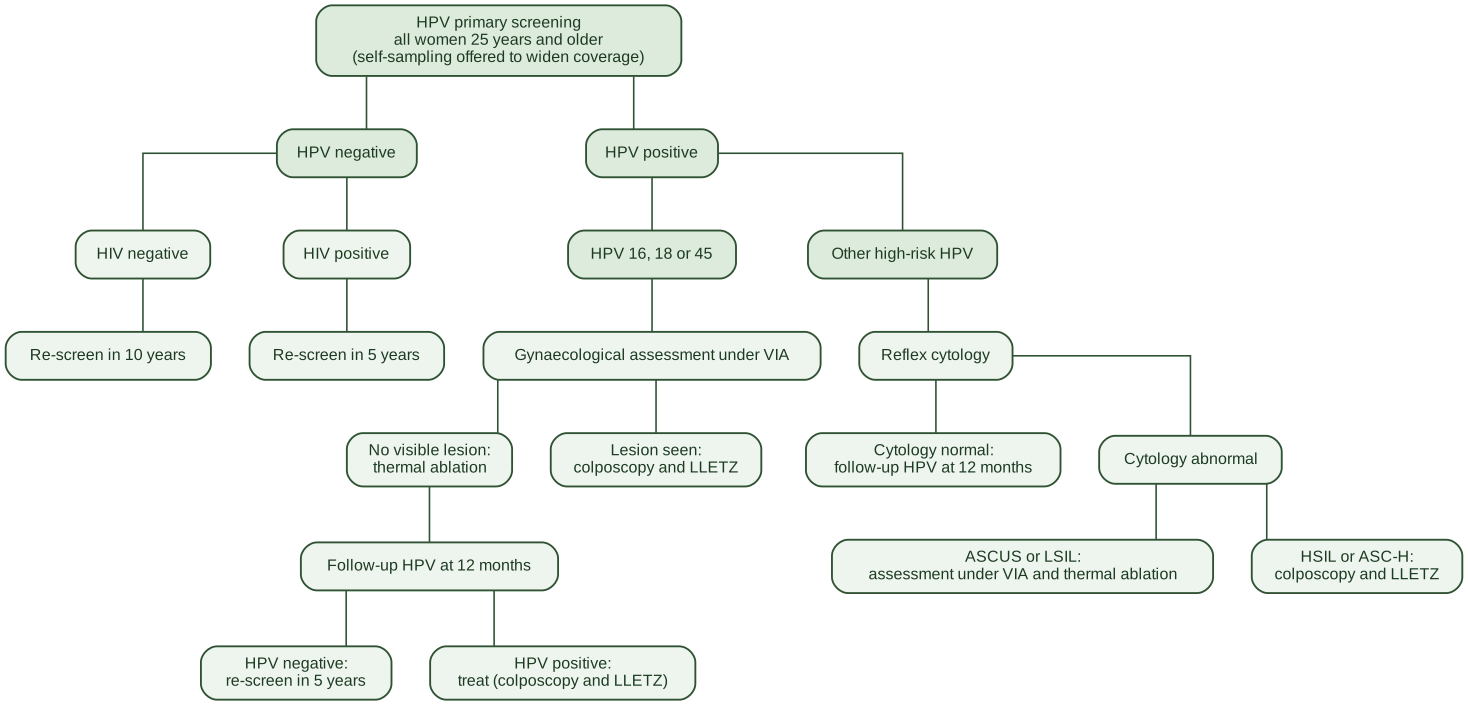
South Africa has adopted primary high-risk HPV DNA testing with partial genotyping, with the national framework setting the policy and the South African Society of Obstetricians and Gynaecologists (SASOG) BetterGyn guideline providing the clinician practice version. The country carries one of the world’s highest burdens, an incidence around 33 to 35 per 100,000, several times the global average and the leading cause of cancer death in younger women, which is the reason the programme is more aggressive than the baseline WHO schedule.
The primary test is a high-risk HPV DNA assay for all eligible women. Screening starts at age 25 regardless of HIV status, a deliberate lowering of the WHO general-population floor of 30, justified by the high HIV prevalence and the early-onset disease that follows it. HPV-negative women are re-screened roughly every ten years if HIV-negative and every five years if living with HIV, for life (the BetterGyn guideline gives the interval as five to ten years by risk). The clinician-collected sample is taken into liquid medium so that, if needed, reflex cytology can be run from the same vial, and self-sampling is endorsed to widen coverage.
The response to the result is genotype-directed.
| HPV DNA result | Action |
|---|---|
| Negative | Routine recall: 10 years if HIV-negative, 5 years if living with HIV |
| Positive for HPV 16, 18 or 45 | Screen-and-treat: assess under VIA, then thermal ablation if no lesion is seen, or colposcopy and LLETZ if a lesion is present; repeat HPV at 12 months |
| Positive for other high-risk types | Reflex cytology to triage (see below) |
When the result is other high-risk (any of the eleven pooled types, not 16, 18 or 45), reflex cytology decides the next step: normal cytology leads to a repeat HPV test in 12 months; low-grade change (ASCUS or low-grade squamous intraepithelial lesion) leads to assessment under VIA and ablation; and high-grade change (high-grade squamous intraepithelial lesion, or atypical squamous cells in which high grade cannot be excluded) leads to colposcopy and LLETZ. The BetterGyn guideline adds a pragmatic refinement: in an HIV-negative woman aged 40 or older, an other-high-risk result may be treated directly without waiting for cytology, because at that age a persistent high-risk infection is itself a strong predictor of underlying disease.
Treatment is delivered close to the point of care, with thermal ablation and LLETZ as the two primary-care modalities and cold-knife conisation reserved for specific indications, and follow-up is by annual HPV testing until negative before returning to routine recall. South Africa aligns to the same elimination target as WHO, below 4 per 100,000 by 2030 and the 90-70-90 milestones, against a current standing that is strong on girls’ vaccination but well short on screening coverage and treatment completion.
HPV assay and result interpretation
The screening step is a qualitative real-time polymerase chain reaction (PCR) test for high-risk HPV DNA. A widely used example detects fourteen high-risk genotypes and, importantly, reports them with partial genotyping: rather than a single positive-or-negative answer, it separates out the most dangerous types individually and pools the rest into groups.
| Reported signal | Genotypes | Share of cervical cancer | Significance |
|---|---|---|---|
| HPV 16 | 16 | ~55 to 60 per cent | The single most oncogenic type |
| HPV 18 | 18 | ~10 to 15 per cent | Disproportionately causes adenocarcinoma |
| HPV 45 | 45 | ~5 per cent | Related to HPV18; also adenocarcinoma-linked |
| Other high-risk A | 31, 33, 52, 58 | ~10 to 15 per cent | With 16/18/45, the nine-valent-vaccine types, about 90 per cent of cases |
| Other high-risk B | 35, 39, 51, 56, 59, 66, 68 | Under 5 per cent | Lower invasive potential; can still cause CIN 2/3 |
Reporting HPV45 individually, alongside 16 and 18, refines the more common 16/18-only design. HPV16 and HPV18 are the two most oncogenic types and together cause about 70 per cent of cervical cancer; HPV18, with the phylogenetically related HPV45, is disproportionately responsible for adenocarcinoma, the glandular form that cytology detects poorly. Grouping 16, 18 and 45 as the highest-risk channel is what lets the algorithm send them straight to treatment, while the lower-risk pooled types are triaged first. A positive signal in any one channel returns an overall result of high-risk HPV positive; all five negative returns a negative result.
Two quality features sit underneath the result and matter for interpretation. A cellular control (a human housekeeping gene) confirms that the sample contained adequate cervical cells and that extraction and amplification worked, so a negative HPV result on a sample with a failed cellular control is unreliable and should be repeated rather than reported as negative. A positive HPV signal remains valid even if the cellular control is out of range, since the virus has plainly been detected. Invalid runs, caused by control or processing failure, are repeated; insufficient samples are rejected and a fresh sample requested. Only specific liquid-based cytology media are validated for the assay; dry swabs and other specimen types are not.
The interpretation that flows from the result mirrors the national algorithm. A negative result returns the woman to routine recall at her risk-based interval. A result positive for HPV 16, 18 or 45 carries the highest risk of underlying or future high-grade disease and prompts treatment or colposcopy directly. A result positive only for the other high-risk types prompts reflex cytology, which then determines whether the woman is referred for colposcopy and treatment or simply re-tested in a year. The single most useful skill in reading these reports is to recognise that the genotype channel, not merely the positive-or-negative result, sets the urgency of the response.
HPV vaccination in South Africa
Vaccination is the primary-prevention arm that screening complements, and South Africa has run a school-based programme since 2014. The global vaccine biology and the full schedule belong to the HPV profile; what follows is the South African programme and its bearing on screening.
The public-sector vaccine is the bivalent vaccine (Cervarix), which targets HPV16 and HPV18, the two types behind about 70 per cent of cervical cancer, and gives some cross-protection against the related types 31, 33 and 45. It is delivered through the Integrated School Health Programme to girls aged 9 to 15, ideally before sexual debut, with the campaign centred on Grade 5 girls and extended by catch-up for those who missed it and, increasingly, to private and independent schools.
The major recent change is the move to a single-dose schedule, adopted on the 2022 WHO recommendation after evidence that one dose protects comparably to two in this age group. This halves the logistical burden and frees supply to widen coverage. Girls who are immunocompromised, including those living with HIV, are the exception and are given a multi-dose schedule, in line with the international recommendation for people with reduced immune responses.
The choice of vaccine bears directly on screening, which is why the two are described together. The bivalent vaccine prevents the HPV16 and HPV18 disease that drives most cervical cancer, and through cross-protection some HPV45 disease, but it does not target the other oncogenic types (31, 33, 52, 58 and the rest) that the nine-valent vaccine (Gardasil 9) covers, nor the low-risk types 6 and 11 that cause genital warts. A vaccinated population therefore still carries residual risk from the non-vaccine high-risk types, which is the very risk that primary HPV screening with genotyping is designed to detect. South Africa has stated it will monitor the case for moving to a next-generation vaccine and for extending vaccination to boys as affordability allows.
References and recommended reading
- World Health Organization. WHO guideline for screening and treatment of cervical pre-cancer lesions for cervical cancer prevention, second edition. World Health Organization; 2021. Available from: https://www.who.int/publications/i/item/9789240040434
- World Health Organization. WHO guideline for screening and treatment of cervical pre-cancer lesions for cervical cancer prevention: use of human papillomavirus (HPV) DNA genotyping. World Health Organization; 2026.
- National Department of Health, South Africa. The Elimination of Cervical Cancer in South Africa: A Strategic and Implementation Framework. National Department of Health, South Africa; 2026.
- Southern African Society of Obstetricians and Gynaecologists (SASOG). Cervical Cancer Screening Guidelines for South Africa (BetterGyn). SASOG BetterGyn programme; 2024.
- National Department of Health, South Africa. Cervical Cancer Prevention and Control Policy. National Department of Health, South Africa; 2017.
- Abbott Molecular. Alinity m HR HPV Assay. Abbott Molecular. Available from: https://www.molecular.abbott/int/en/products/infectious-disease/alinity-m-hr-hpv-assay
- World Health Organization. Human papillomavirus vaccines: WHO position paper (2022 update). Weekly Epidemiological Record. 2022;97(50):645-672. Available from: https://www.who.int/publications/i/item/who-wer9750-645-672